
Home Turf
Farnworth and Appleton Cricket and Football Club was established on a field where Ross Street now stands.
Soon the little, unfenced, village ground became inadequate, and, with great pride and sense of achievement the Widnes Football Club moved to a properly fenced enclosure just off Peel House Lane at Mill Brow. This was in 1878, after a brief spell at another unfenced ground at Simms Cross.
In the 1880-81 season, the Peel House Lane ground became unfit due to torrential rain and drainage problems, and for a spell Widnes FC played on Widnes Cricket Field, for a small rental
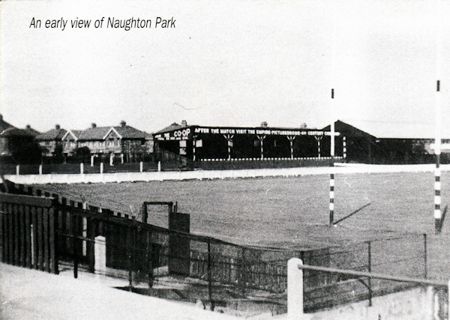
In 1884 came the move to Lowerhouse Lane. That land was leased on behalf of the rugby organisation by Widnes Cricket Club but, to coincide with the breakaway from the Rugby Football Union in 1895, Widnes FC obtained a lease for land on which they laid out a new ground (Naughton Park / Stobart Stadium site). The first game on the new field was against Liversedge on 12 October 1895.
In the late 1920s it was proposed that the land would be compulsorily purchased to make way for a new council housing scheme. After much lobbying the club were finally given an option to purchase the site for the not inconsiderable sum of £3,250.
Club secretary Tom Naughton was instrumental in raising the necessary funds but before the formal completion of the purchase in 1932 he died in a car crash, leading to the ground being renamed in his honour.
Naughton Park became one of the best known Rugby League grounds in the country due to the success of the "Chemics", the Widnes teams nickname due to the towns chemical industries and their sponsorship from ICI. However, with each success the crowds attending the teams games grew and after two fires at the ground steps were taken to improve the site.
Naughton Park stadium was owned by Widnes RLFC but when financial difficulties set in they sold the ground to Halton Borough Council in 1995.
Halton Borough Council in partnership with the club agreed to build a new stadium on the site of Naughton Park. This stadium would provide a multi-purpose complex including a social club, conference facilities, recreational facilities and catering/function facilities.
The Halton Stadium is an all-seater stadium built on the site of the former Naughton Park on Lowerhouse Lane.
Designed and built to provide far more than a world class arena for sporting events, the Stadium also provides function and banqueting facilities for the residential area and outstanding hi-tech conference facilities for business communities of Halton and beyond.
It was agreed that Halton Council in partnership with the Widnes Vikings would build a new stadium on the existing site. This stadium would provide a multi-purpose complex including a social club, conference facilities, recreational facilities and catering/function facilities. This would be the new home venue for Widnes Vikings. The stadium was officially opened on 2 November 1997 following the completion of phase 1 of a multi-million pound redevelopment of the old Naughton Park site.
On 29 January 1999 Halton Borough Council took over responsibility for the entire Stadium, both financially and managerially. This was necessary as the joint venture companies arrangements were not performing as expected.
The Stadium reached completion with the opening of the East Stand in September 2005. The Stobart Stadium Halton is an all-seater Stadium which has a capacity of 13,393. It has also had the honour to have staged national finals and international fixtures.
This additional stand not only increased the capacity of the Stadium, it also provided a table tennis centre of excellence to Regional standard, a health and fitness facility, a créche and a state of the art injury clinic.
| North Stand | South Stand | East Stand | West Stand | Total | |
| Number of seats | 4,181 | 3,747 | 2,443 | 3,022 | 13,393 |
| Building | Start | End | Cost | Grant |
| Nth/Sth Stands | Aug 1996 | Nov 1997 | £4.5m | None |
| West Stand | Jun 1998 | Aug 1999 | £3.1m | £2.31m (Sport England) |
| East Stand | Sep 2005 |